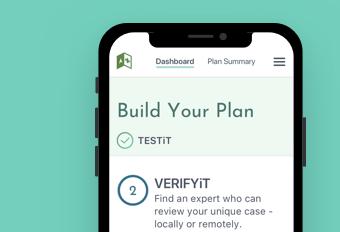
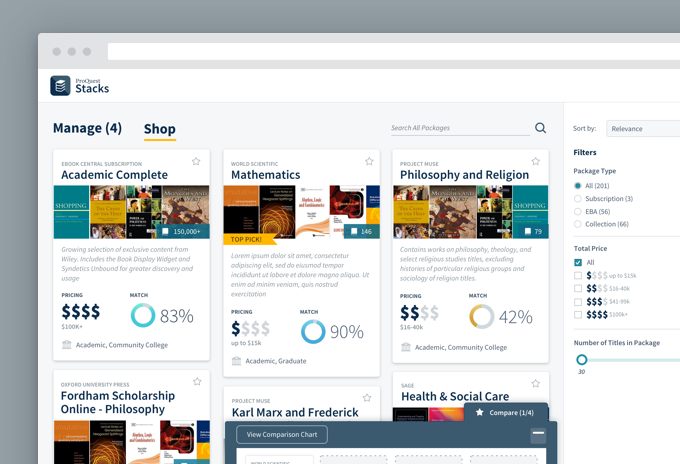

ProQuest Stacks

ROLE
UX Lead
2019

TOOLS
Sketch
InVision

SKILLS
UX Design
UI Design
User Research
Publishers often mentioned having a strong incentive to sell packages of books to academic libraries. However, a poor shopping and management experience resulted in a disincentive for librarians to engage in this sales model.
- Packages sometimes had complex and varying usage terms
- By and large, the packages could only be accessed and purchased directly through publishers which led to fragmented evaluation and purchasing processes.
- Librarians often struggled to collect metrics and other important information to help them decide if a package was an acceptable fit. They relied heavily on the information the publisher provided or ran complex queries on their own databases to figure out if a package fit with their needs.
I then led an effort to explore how ProQuest could alleviate many of these pain points by offering a better package shopping and management platform. My efforts focused on answering questions such as:
- What type of features would be essential to support a new package marketplace?
- Will users feel excited by and feel compelled to use a new product like this?
- Which features and information mattered most to users when evaluating and managing packages?
- Approximately, how much time and resources would it take to build a user-friendly product that would generate a substantial new channel of revenue?
Target Persona
This product would primarily serve Collection Development Coordinators who often initiated and oversaw larger title purchases. This person often led a small committee of Subject Librarians and Faculty with a background related to the package in consideration to help him decide on a purchase.
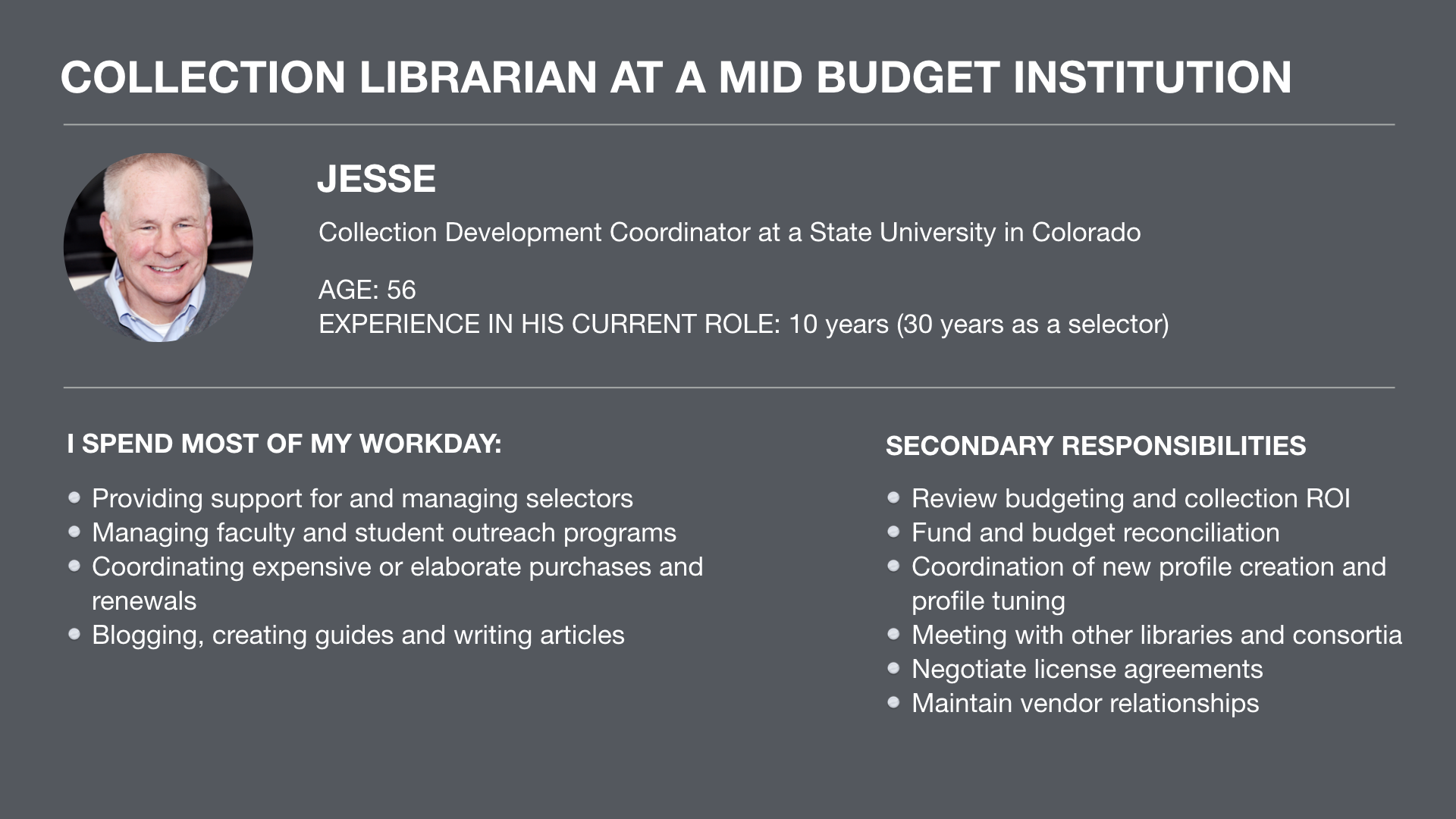
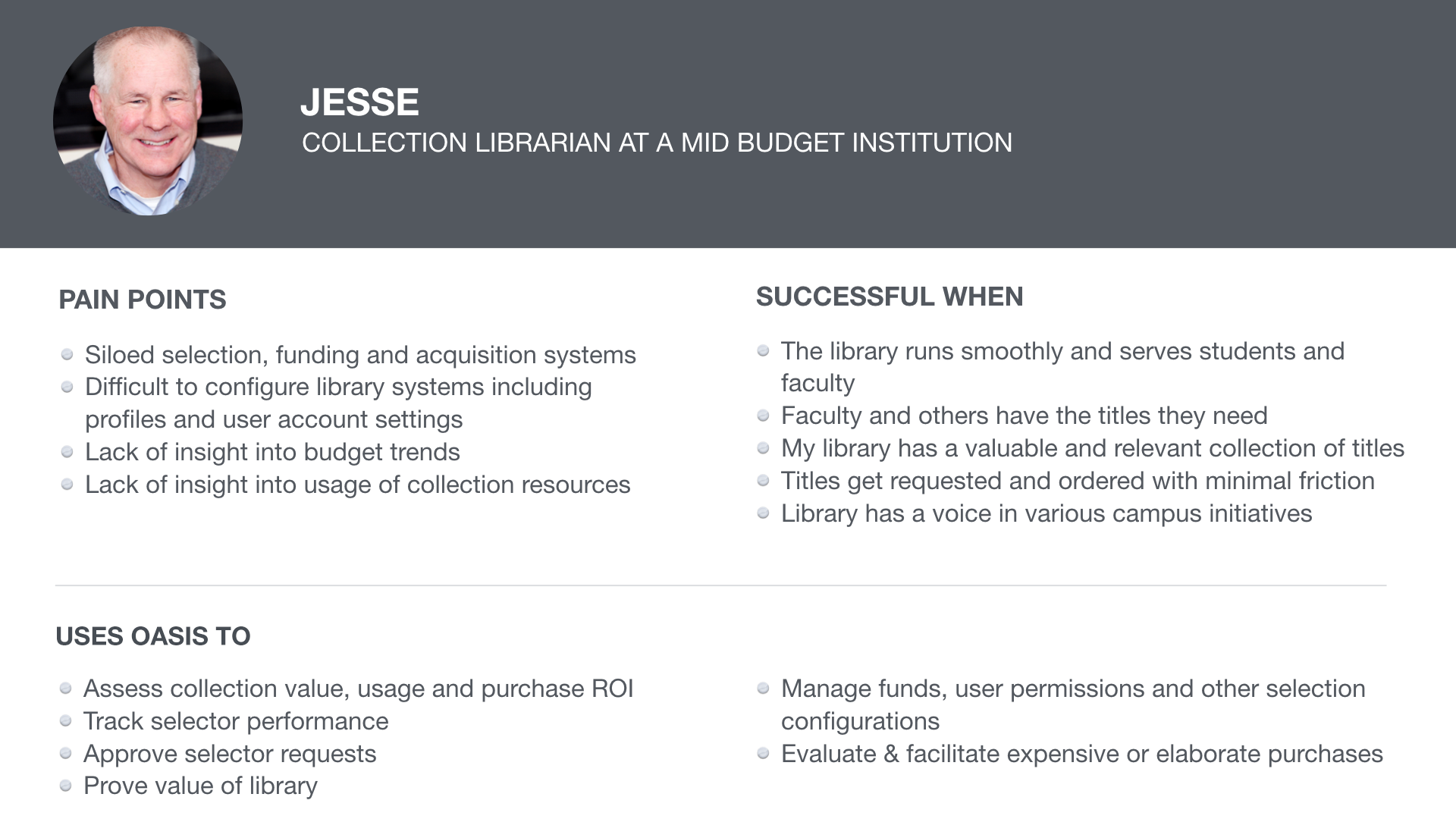
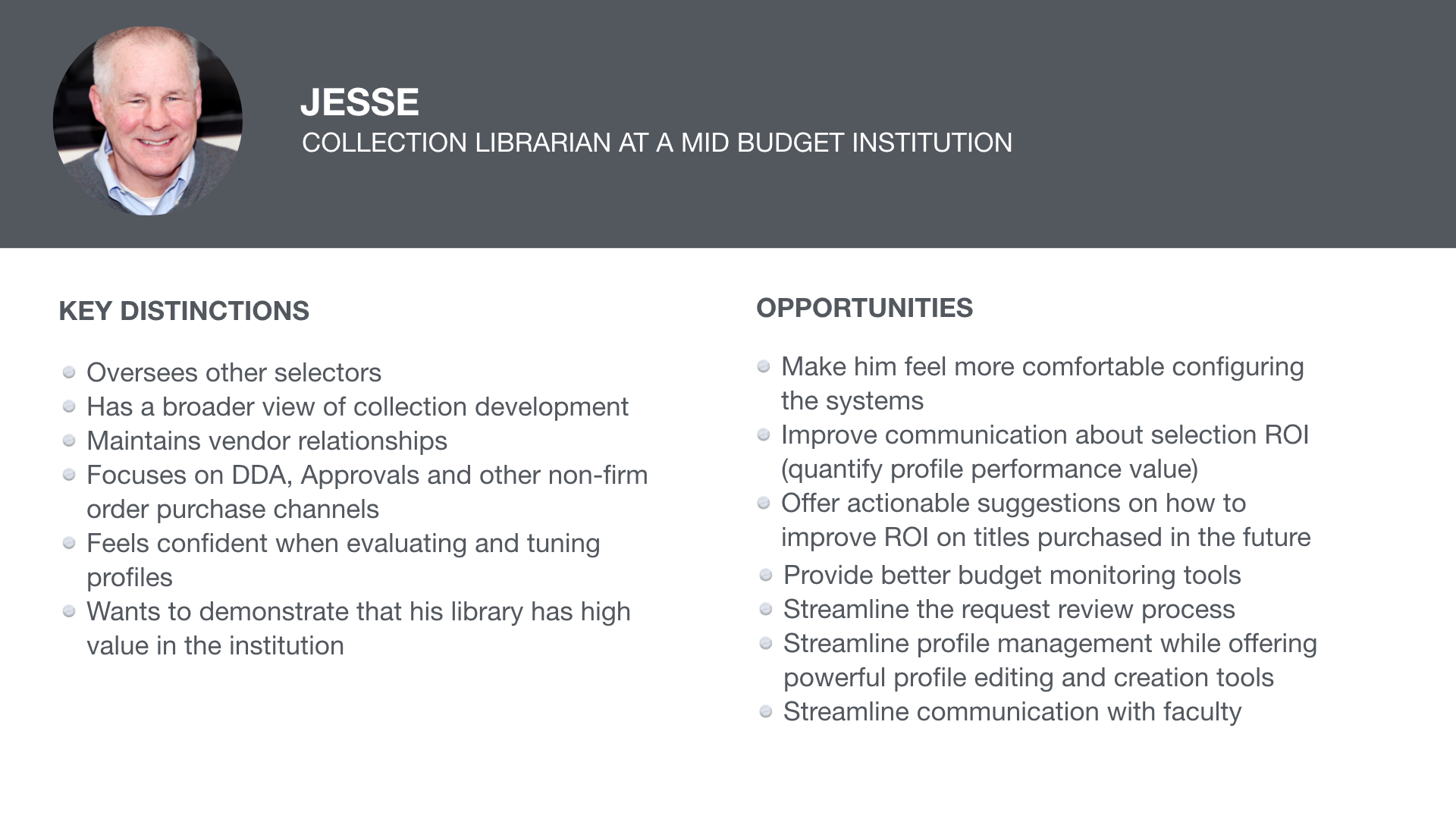
Most of Jesse’s energy focused on determining if a package had an acceptable level of relevance and value. Jesse aimed to buy packages within a specific budget which contained titles that would get used regularly. He also wanted to minimize the amount overlap between titles his library already owned and the titles in the package.
Secondarily, this product targeted Selector Librarians who could offer subject-specific feedback during the evaluation and purchasing processes.
Adding Value
We believed that ProQuest was uniquely positioned to add value in this area because:
- The marketplace would feature a range of package types from a wide set of publishers. Librarians could shop for and compare an unprecented range packages within one consistent, integrated and simple user experience.
- ProQuest had access to a large database of library holdings and usage metrics which could help point librarians towards more relevant and valuable packages.
- The new product could offer a superior user experience which seamlessly integrated with other ProQuest tools leading to more efficient and user-friendly workflows. Librarians had expressed a lack of desire to buy packages because of the poor quality and disjointed user experience. Presumably, if we solved some of the core pain points, librarians would end up buying more packages and feel more satisfied with the packages they purchased.
My work aimed to visualize, flesh out and evaluate these hypotheses.
Discovery, Design & Iteration
Initially, the product team assumed that the marketplace would follow the familiar e-commerce model involving shopping carts and checkouts. However, after speaking with several users and stakeholders, it quickly became apparent that librarians did not shop for packages like they shop online for consumer goods on e-commerce sites.
- Packages were often one-time large purchases which required a significant percentage of their budgets.
- Librarians often had a specific subject area or publisher in mind when initiating a shopping experience.
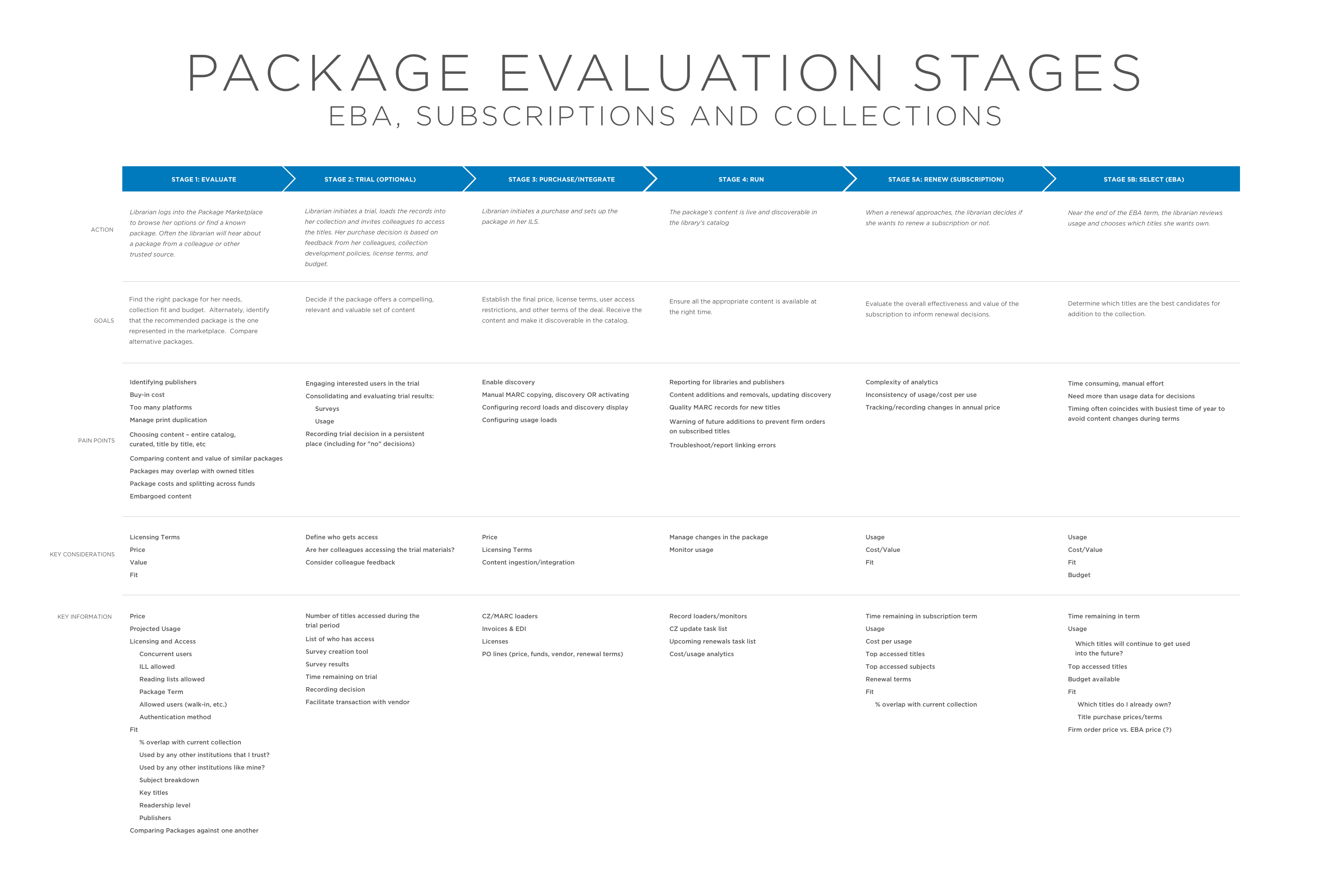
- Librarians conducted significant due diligence when evaluating packages. Often, they would load the entire package into their library systems and run a trial for a month before deciding on a purchase.
- The purchasing process often involved contractual price and licensing negotiations.
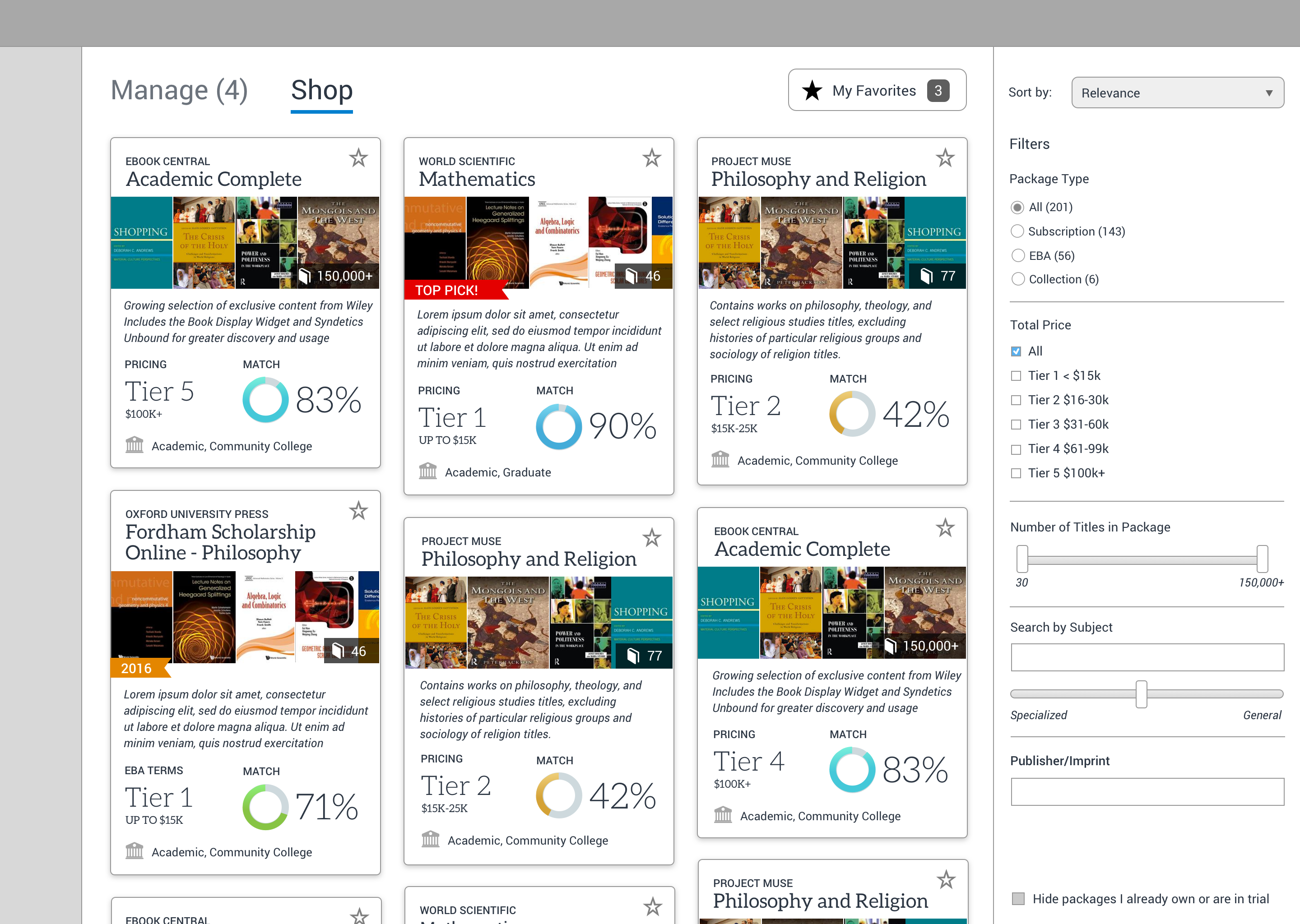
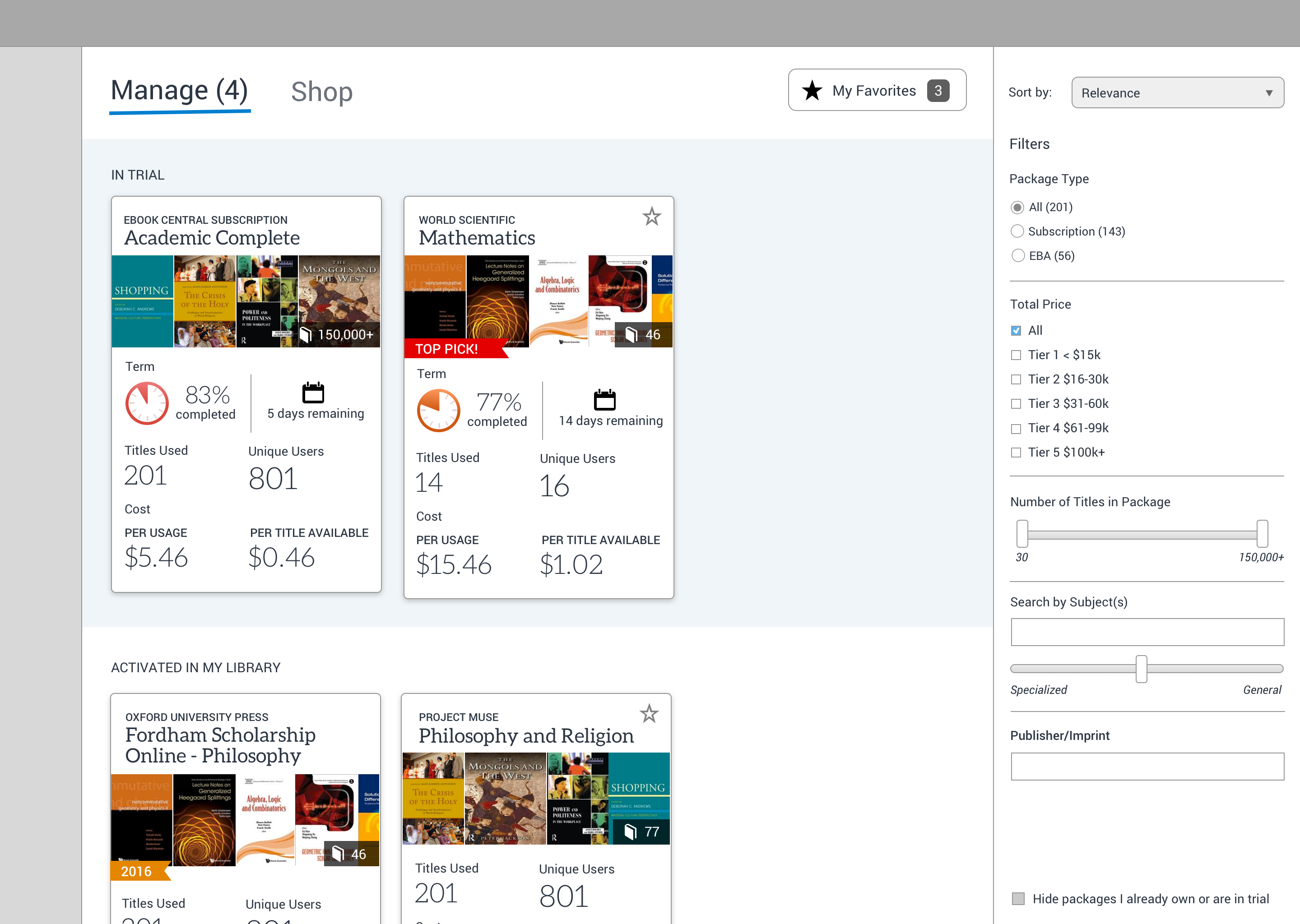
- Librarians needed visibility into which packages they had already evaluated or purchased.
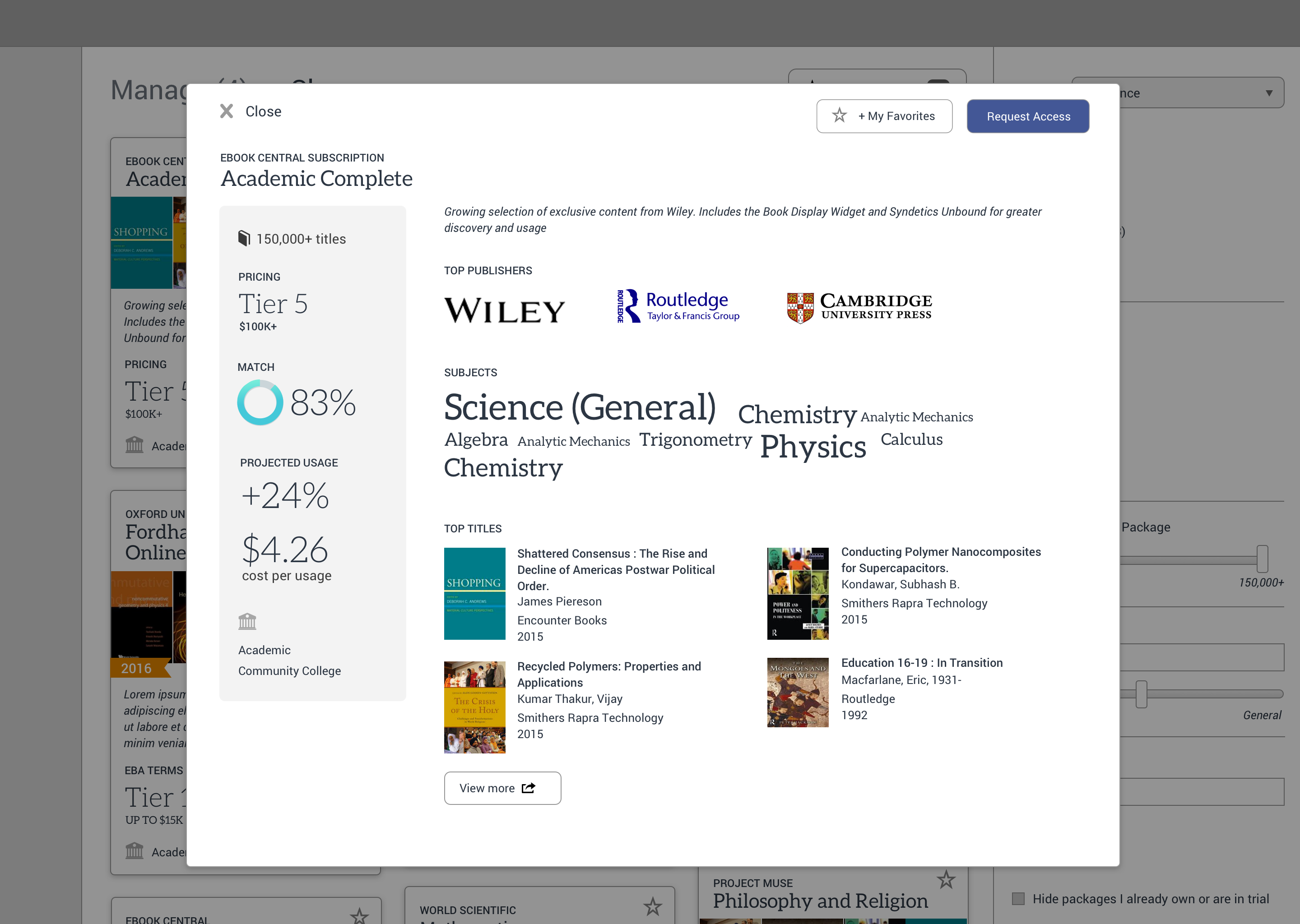
More Like Shopping for a Car
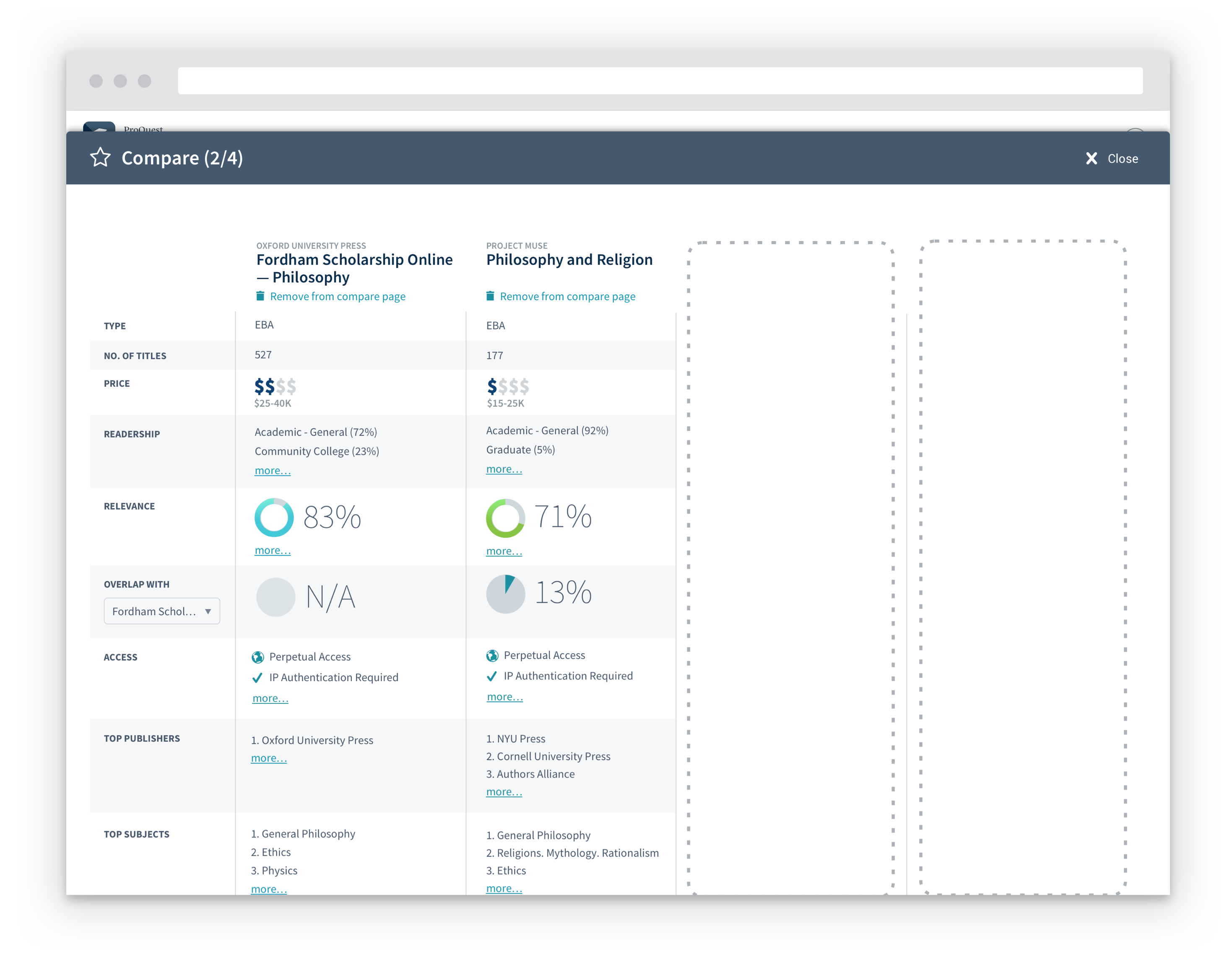
As I grew to understand how librarians approached packaged title purchases, I began gravitating towards car shopping experiences. In many ways, package shopping behaviors mirrored those of car buyers. Like with a car purchase, price and fit emerged as top considerations. Librarians often wanted to deeply evaluate a package and “test drive” it before buying. They also expected some negotiation to occur after they moved forward with a purchase. The design evolved to reflect these insights. For instance, I added a comparison tool which allowed the user to directly compare up to 4 packages against one another.
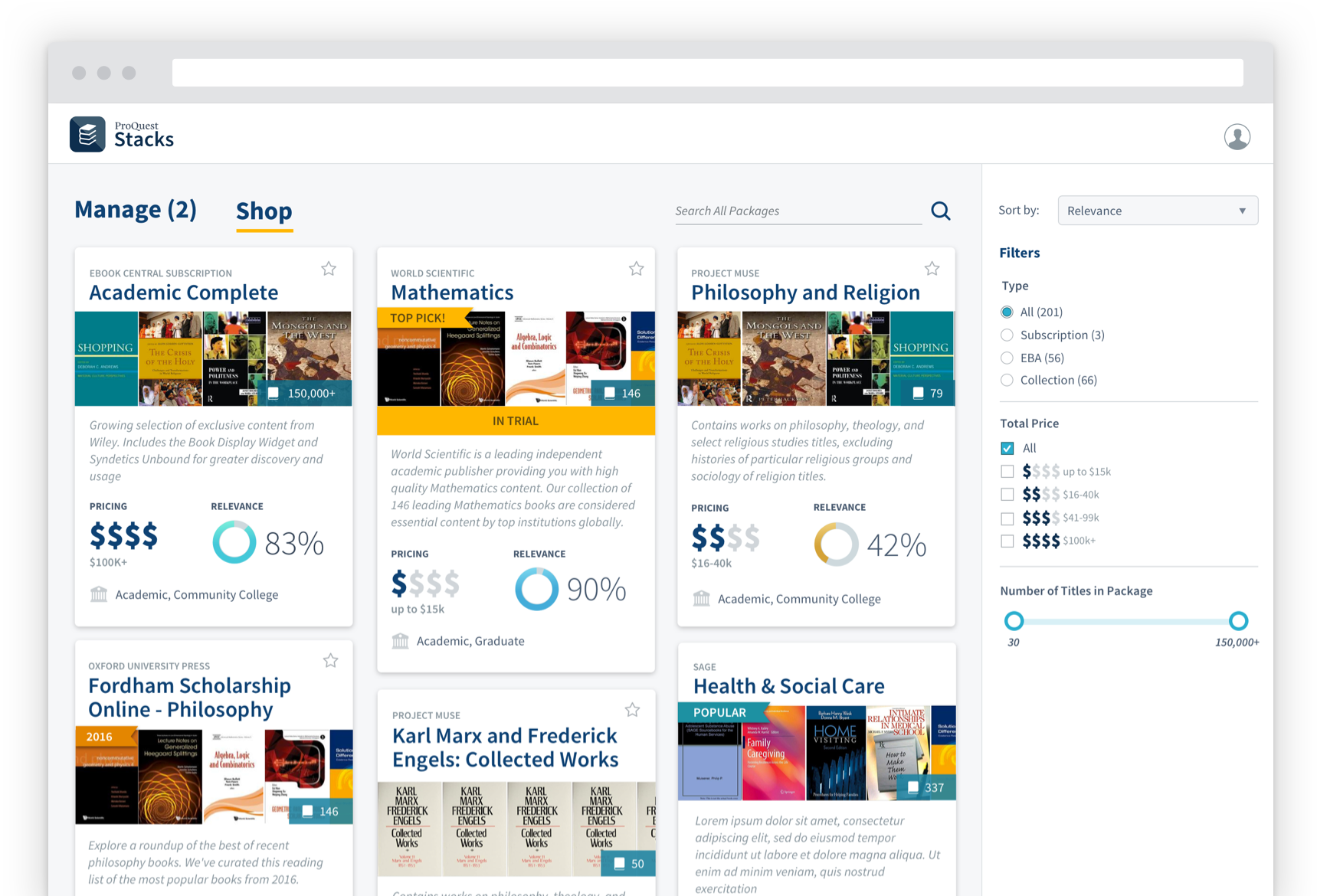
Evaluation & Iteration
I worked with various stakeholders to create a prototype which offered a realistic and tangible expression of the product concept. This prototype served as a central reference point when speaking with users. It also helped stakeholders and decision-makers visualize and understand how this idea would materialize.
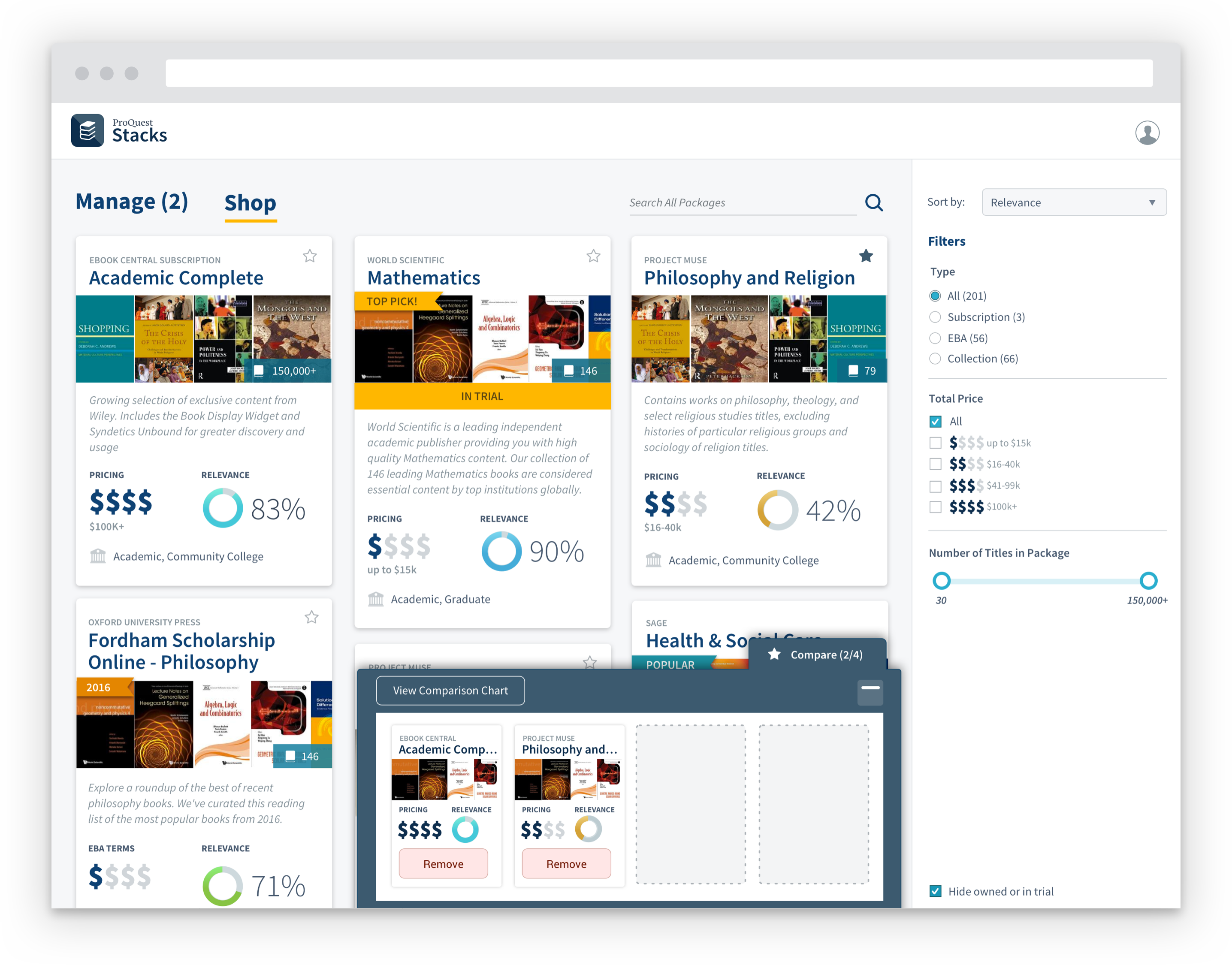
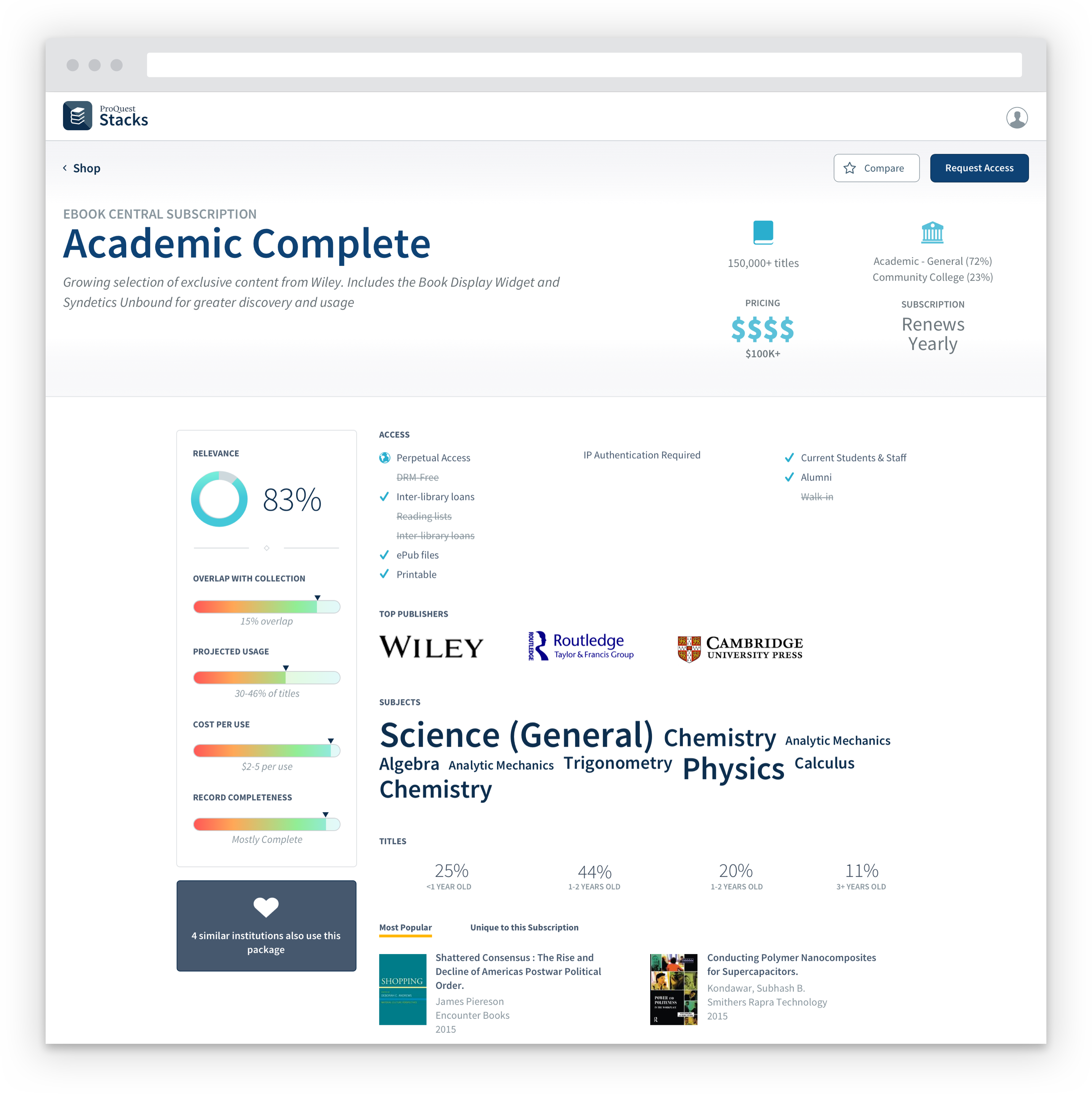
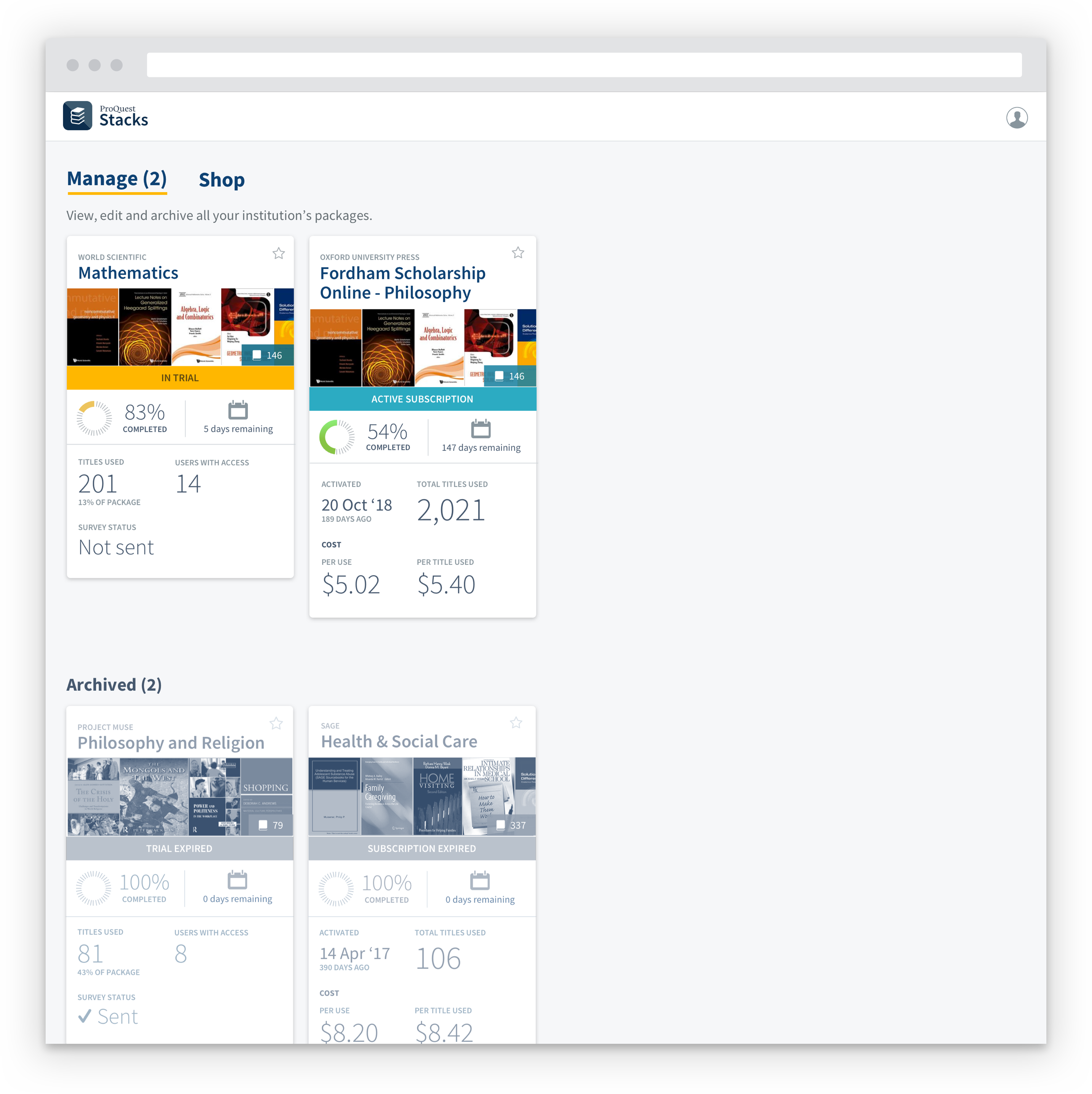
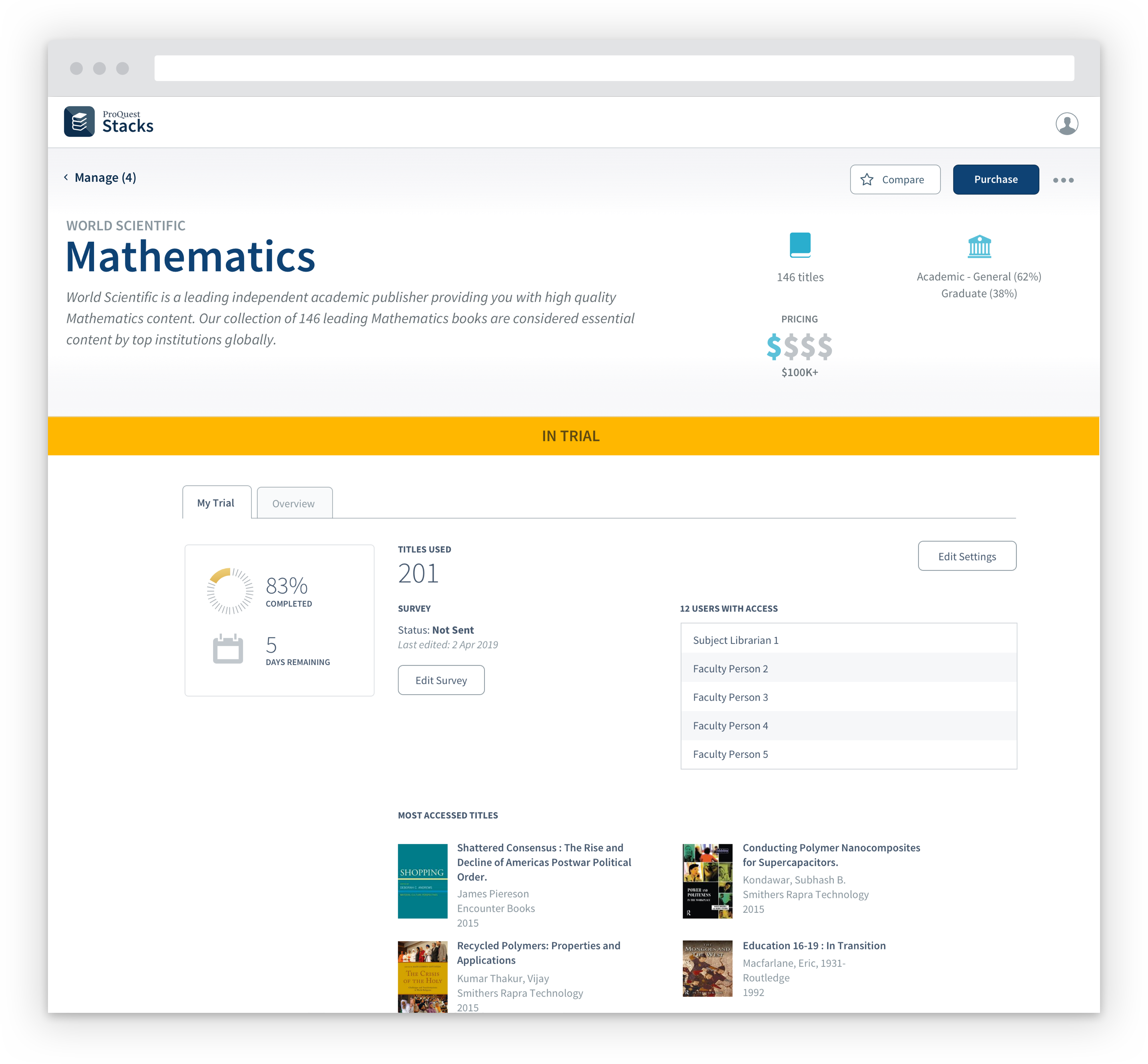
With an initial prototype in hand, I led a group discussion with over 15 librarians from across the world to ask about their processes, goals and motivations. From this session, I learned several new key insights:
- Price and fit were reiterated as primary considerations
- Librarians wanted to know how recently the titles in a package had been published. They often regarded older titles as “filler.”
- Librarians brought up some additional attributes which had not been identified during the initial discovery process:
- Accessibility. Academic Libraries often required all user-facing tools to adhere to stringent accessibility requirements
- Usability. Librarians wanted to make sure the titles they purchased would be available in a user-friendly reading interface.
- Quality of Metadata. Sometimes packages offered files with incomplete or missing data which made them harder to find and use.
When presented with a prototype, users generally seemed excited about the new product and recognized its overall value. Users identified some confusing language, expressed confusion over the package rating metrics and suggested better ways to compare packages to one another.
Conclusions & Reflections
The investigation unearthed a much larger scope than the team had initially anticipated. Most unexpectedly, users would need to way to understand which packages she already owns, which she has in trial and which she already reviewed. Moreover, the business identified some significant risks would could jeapordize the success of the product. Namely, users could find a package to purchase inside Stacks then initiate the transaction outside of our established channels.
However, the project unearthed some important learnings which could be leveraged in other future projects. Personally, I learned quite a few insights related to User Experience Design:
- Not all shopping experiences need a cart and checkout. Initially, the team had assumed that this marketplace would need some kind of cart and checkout process. But as we delved more deeply into the process and psycology of our users, we felt that a traditional e-commerce flow did not accommodate their shopping needs
- Context matters. When testing the prototype, users had assumed that the information we presented would mirror the information publishers showed them when evaluating a package. As such, we discovered that users misinterpreted several labels and graphic presentations because they expected we’d mirror the language publishers used.